

For the 2026 GCSE exams, AQA, OCR, and Pearson Edexcel will each provide official formula and equation sheets as printed inserts inside the relevant question papers. DfE and Ofqual confirmed this arrangement covers the 2025–2027 assessment window, so every student sitting the relevant papers in 2026 will receive one automatically. You do not need to bring your own copy on exam day.
The subjects covered are:
- GCSE Mathematics (Foundation and Higher Tier sheets differ by board)
- GCSE Physics (separate equation sheets, with Higher Tier items labelled HT)
- GCSE Combined Science (Trilogy and Synergy, with HT labelling)
Check which tier you are entered for before downloading any PDF for revision. Using the wrong tier sheet in mocks gives you a false picture of what will be in front of you on the day.
Having the sheet does not mean you can skip practising with it. Speed matters. The students who gain marks are the ones who can find, read, and apply a formula in under thirty seconds, not the ones who are still flicking through pages when time is called.
Key takeaways
The single most important action you can take right now is to download the correct board and tier PDF and use it in every mock from this point forward.
| Point | Details |
|---|---|
| Official sheets confirmed for 2026 | DfE and Ofqual confirmed inserts for Maths, Physics, and Combined Science across 2025–2027. |
| Download the right board and tier PDF | AQA, OCR, and Edexcel each publish separate PDFs; Foundation and Higher versions differ. |
| HT labelling matters | Higher Tier equations are marked HT; using the wrong tier sheet in mocks creates false confidence. |
| Practise speed, not just recognition | Build formula-location drills into every mock; aim for under forty-five seconds per look-up. |
| Examrevizo for matched mock practice | Examrevizo practice papers and the Atlas AI assistant support full mock sessions using the official 2026 sheets. |
Table of Contents
- Where can you download the official 2026 formula sheets?
- Which subjects and tiers get a sheet in 2026?
- What types of formulae and equations are on the sheets?
- How to use the official 2026 sheets effectively in revision
- How to confirm you will get the right sheet on exam day
- Your one-page checklist for the week before the exam
- Why practising with the sheet is the real revision skill
- Examrevizo practice papers matched to the 2026 sheets
- Sources
Where can you download the official 2026 formula sheets?
Each exam board publishes its own PDFs. Download the one that matches your board and tier, then use it in every mock from now until June.
| Board | Subject | Tier | Where to download |
|---|---|---|---|
| AQA | GCSE Mathematics | Foundation and Higher | AQA formulae and equation sheets page |
| AQA | GCSE Physics / Combined Science | Foundation and Higher | Same AQA page above |
| OCR | GCSE Physics A (equation sheet) | Foundation and Higher (HT labelled) | OCR Physics A equation sheet PDF |
| OCR | GCSE Physics B (data sheet) | Foundation and Higher (HT labelled) | OCR Physics B data sheet PDF |
| OCR | All 2026 formulae and equation sheets | All subjects | OCR subject updates page |
| Pearson Edexcel | GCSE Mathematics Higher Tier | Higher | Edexcel Higher Tier maths formula sheet |
OCR explicitly states the 2026 sheets are available now for use in teaching and mock assessments, so there is no reason to wait. AQA confirms the 2026 content is identical to 2025, meaning any sheet labelled for the 2025 series is valid for 2026 revision. Pearson Edexcel's published aid confirms the insert will be provided on the day of the examination.
Which subjects and tiers get a sheet in 2026?
Not every GCSE subject comes with a formula sheet. The three areas covered by the DfE/Ofqual arrangement are Mathematics, Physics, and Combined Science. Here is how the tier split works in practice.
The HT label is the detail most students overlook. OCR's Physics A equation sheet marks Higher Tier items clearly as "HT" throughout the four-page insert. If you are sitting Foundation Tier, those equations will not appear in your questions. Revising them wastes time and, worse, can create confusion when you sit the actual paper and find the sheet looks different from the one you practised with.
Foundation Tier maths sheets carry fewer formulae than Higher Tier versions. The difference is not trivial: some algebraic and trigonometric identities appear only on the Higher sheet. Confirm your tier with your teacher or exams officer before printing anything.
What types of formulae and equations are on the sheets?
The sheets cover four broad categories, and knowing which category a formula falls into helps you find it faster under exam pressure.
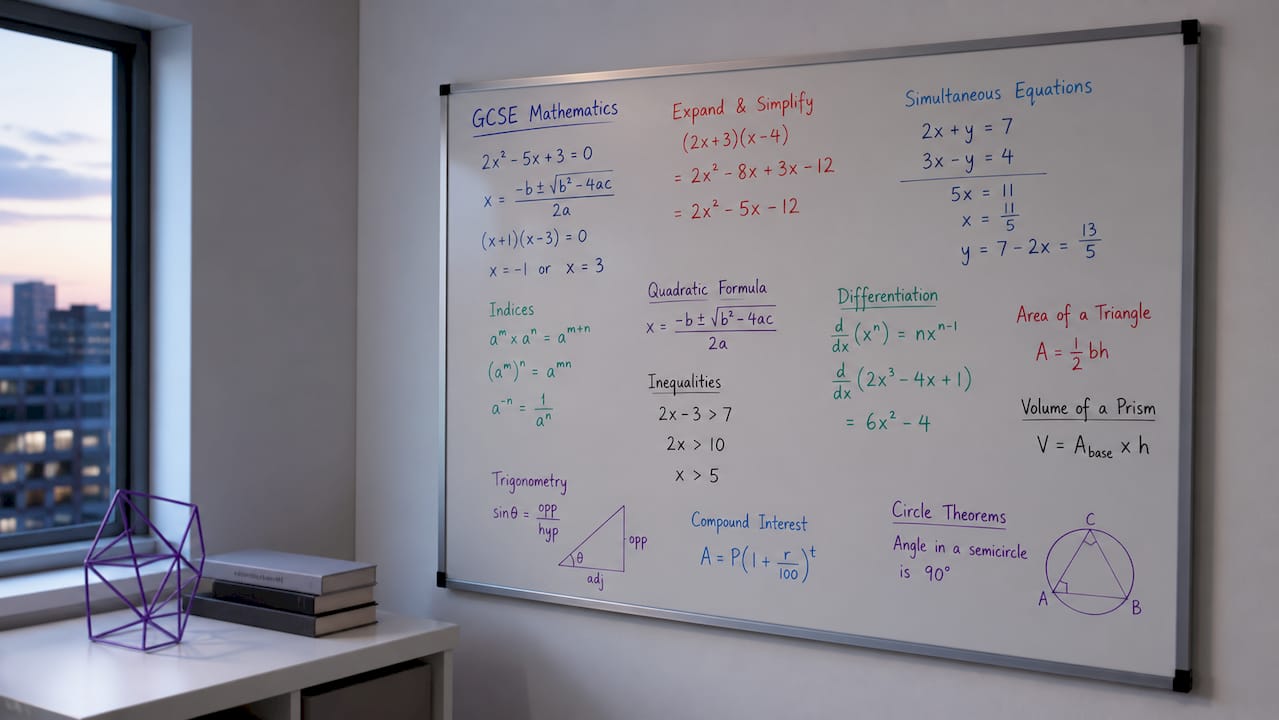
Mathematics sheets include geometry formulae (area of a trapezium, circumference and area of a circle), trigonometric ratios, the quadratic formula, and statistical measures such as the formula for the mean from a frequency table. Higher Tier sheets add further algebraic identities and the sine and cosine rules.
Physics and Combined Science sheets cover kinematics (v = u + at, s = ut + ½at²), energy (E = ½mv², P = IV), electricity (V = IR, P = I²R), waves (v = fλ), and physical constants such as gravitational field strength and the speed of light. OCR's Physics B data sheet groups these by topic area and includes brief exam instructions on the sheet itself.
One thing that catches students out: some formulae still appear inside individual question prompts rather than on the general insert. OCR advises that certain complex formulae, such as curved surface area expressions, may be given within the question. Always scan the question text before assuming a formula is missing from your sheet.
Pro Tip: When you first open the sheet in a mock, spend sixty seconds reading the section headings, not the individual formulae. Knowing where each category lives means you navigate by section rather than scanning every line.
Symbols like ρ (density), Δ (change in), and g (gravitational field strength) appear without explanation on the sheet. Spend ten minutes with your sheet before your first mock just reading the notation. It removes the moment of hesitation that costs marks.
How to use the official 2026 sheets effectively in revision
The goal is not familiarity with the sheet. It is speed. Here is a structured six-week routine that builds both.
Six-week plan:
- Week 1: Download your board and tier PDF. Read through it once without a pen. Note which sections feel unfamiliar.
- Week 2: Introduce the sheet into guided practice. For each topic, find the relevant formula on the sheet before attempting questions. Time yourself.
- Week 3: Run a timed "find-and-apply" drill. Pick ten past-paper questions at random, locate the formula on the sheet, and apply it. Aim for under forty-five seconds per formula location.
- Week 4: Complete a full mock paper using only the official PDF as your formula source. No revision notes, no textbook. Mark it honestly.
- Week 5: Identify the three formulae that took you longest to find. Practise those specifically with a ten-question speed drill.
- Week 6: Final full mock under timed conditions. Check the sheet only when you genuinely need it.
Practical checklist for mock conditions:
- Use the exact PDF for your board and tier, printed or on screen
- No annotations on the sheet during the mock (exam conditions do not permit writing on the insert)
- Scan each question for embedded formulae before turning to the sheet
- Record how long formula look-ups take and aim to reduce it each session
- After the mock, review every question where you used the sheet and check you applied the formula correctly
OCR's guidance confirms the sheets are available now for teaching and mock use, so there is no reason to delay integrating them.
How to confirm you will get the right sheet on exam day
A few quick checks now prevent a stressful surprise in the exam hall.
- Confirm your entry tier with your teacher or exams officer. Your tier determines which sheet insert is placed in your paper.
- Check your exam timetable and paper codes. The paper code tells you which board and specification you are sitting. Match it to the correct PDF on the board's website.
- Download and print the exact PDF for your board, tier, and subject. Use it in every mock from now on.
- If anything looks inconsistent (your mock sheet differs from what your teacher uses, or your tier entry seems wrong), speak to your school's exams officer before the exam series begins.
- Paper format: the sheet is a printed insert inside the question paper booklet. There is no separate digital version for standard written exams. If you have access arrangements, confirm with your exams officer how the insert will be provided for your sitting.
The OCR Physics A sheet, for example, includes a printed instruction line stating the sheet should not be sent for marking and should be kept at the centre or recycled. Knowing that in advance means you will not be confused by those instructions on exam day.
Your one-page checklist for the week before the exam
Print this out and pin it where you revise.
- Download the correct PDF for your exam board, subject, and tier.
- Print one copy to use in your final mock this week.
- Complete one timed mock using only the sheet as your formula source.
- Run a ten-question formula-location drill on the three formulae you find slowest.
- Check your exam timetable: confirm the paper code and your entry tier.
- Speak to your exams officer if your tier or board entry looks wrong.
- Remind yourself that some formulae appear inside question prompts — scan each question before reaching for the sheet.
- On exam morning, do not bring your own annotated copy. The insert will be inside your paper.
- In the exam, spend the first sixty seconds locating the section headings on the sheet before you start writing.
- After the exam, leave the sheet at the centre as instructed.
For teachers and parents: run a mock session this week using the official PDF as the only formula resource. Time how long students take to locate three specific formulae. That single exercise reveals more about exam readiness than a full revision session without the sheet.
Why practising with the sheet is the real revision skill
Most students treat the formula sheet as a safety net. That is the wrong mental model. The sheet is a tool, and like any tool, it rewards the people who have used it repeatedly before they need it under pressure.
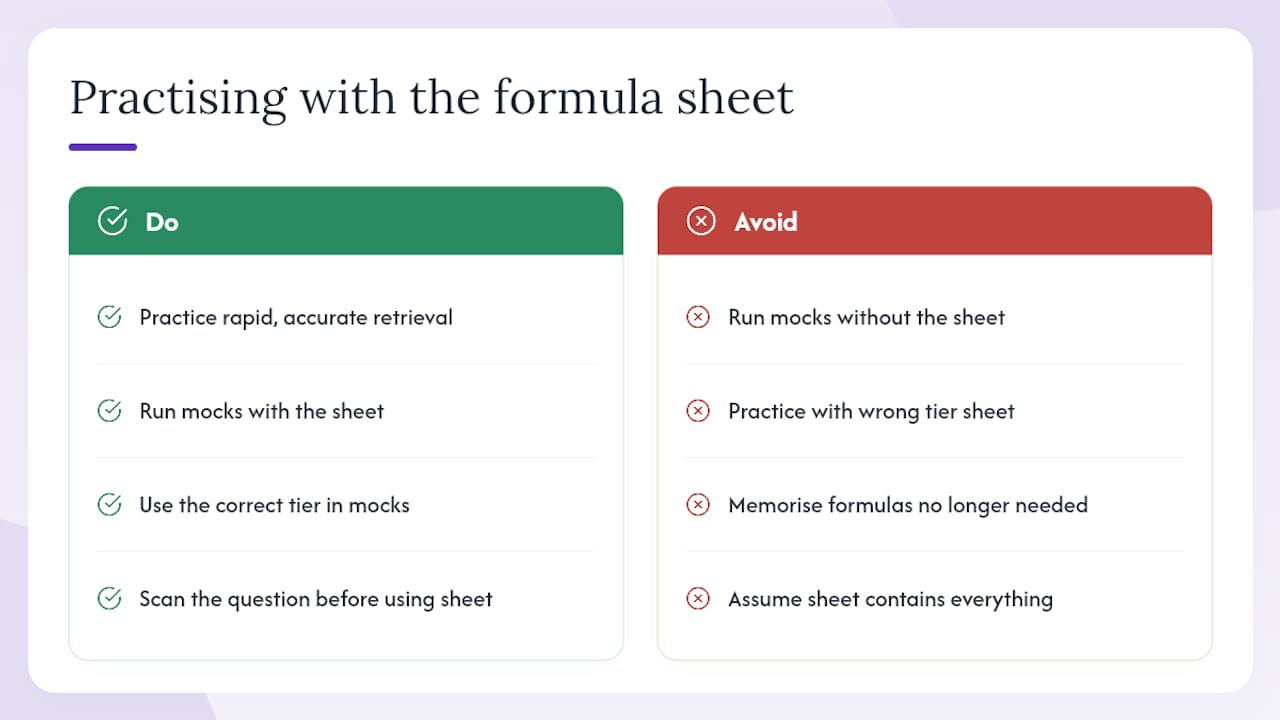
The DfE and Ofqual decision to provide sheets across the 2025–2027 window was designed to shift assessment toward application rather than rote recall. That is a meaningful change. But it creates a new risk: students who spend revision time memorising formulae they no longer need to memorise, while neglecting the skill of rapid, accurate retrieval from the sheet itself.
The students who benefit most are those who treat the sheet as part of their exam technique, not as a fallback. Every mock you run without the sheet is a missed opportunity to build that technique. Every mock you run with the wrong tier sheet is practice for an exam that does not exist.
There is also the question of embedded formulae. OCR advises that some expressions still appear inside individual question prompts. Students who assume the sheet contains everything they need will miss those prompts entirely. Scanning the question before reaching for the sheet is a habit worth building from week one.
Examrevizo practice papers matched to the 2026 sheets
Knowing where to find the official PDFs is one part of the picture. Practising with papers that mirror the 2026 exam format is the other.

Examrevizo's GCSE practice papers are built to match official exam formats, so you can run full mocks using your board PDF as the only formula source. The Atlas AI assistant explains any formula you are unsure about, generates exam-style questions on demand, and gives structured feedback on your answers. The GCSE Science Bundle covers Physics and Combined Science with papers and mark schemes that align to the 2026 specification. Use the grade boundaries estimator after each mock to track where you stand and what to prioritise next.
Pro Tip: During any Examrevizo mock, close your revision notes and use only the official board PDF as your formula source. That single constraint turns a practice paper into a genuine exam simulation.
Visit Examrevizo to find the right papers for your board and tier, and start building the speed and confidence you need for June.
Sources
- GCSE Maths and GCSE Sciences formulae and equation sheets for 2025-2027
- Ocr
- Ocr
- Edexcel GCSE (9-1) Mathematics: Higher Tier Exam Aid
- Decisions on changes to the assessment of mathematics, physics and combined science GCSEs in 2025, 2026 and 2027