

A predicted GCSE grade is a teacher's evidence-based estimate of the grade you are most likely to achieve in a subject when you sit your final exams. It is not a guarantee, and it is not fixed. Here is what to do right now:
- Check your mock results. These are the single biggest piece of evidence most teachers use.
- Ask your teacher what evidence they used. A polite, specific question gets a useful answer.
- Plan targeted revision. Once you know where the gaps are, you can close them before predictions are finalised.
Predictions are working estimates. Students improve them all the time.
Key takeaways
Predicted GCSE grades are teacher estimates based on current evidence, and they can be revised when you show consistent, documented improvement.
| Point | Details |
|---|---|
| What a prediction is | A teacher's evidence-based estimate of your most likely grade, not a guarantee or a final result. |
| Key evidence types | Mock exams carry the most weight; classwork, past papers, and coursework also contribute. |
| Timing | Most predictions are set after the main mock series in January/February, with final reporting due 4 August 2026. |
| How to improve yours | Bring marked past papers showing an upward trend and request a review conversation with your teacher. |
| Examrevizo | Tracks topic mastery and logs practice-paper progress to help you build a concrete evidence trail for teacher review. |
Table of Contents
- How are predicted GCSE grades calculated?
- How accurate are predicted GCSE grades?
- When are predictions set and who gets to see them?
- Do predicted GCSE grades actually matter?
- How can you improve your predicted GCSE grade?
- Common myths about predicted GCSE grades
- How do predicted grades differ from your actual GCSE results?
- What do Ofqual and awarding organisations say about predictions?
- How to formally query or appeal a predicted grade
- How predicted grades shape your post-16 options
- Predictions are a starting point, not a ceiling
- Examrevizo helps you build the evidence that changes predictions
- Sources
How are predicted GCSE grades calculated?
Teachers draw on several types of evidence when forming a GCSE grade prediction, and no single piece is decisive on its own.
The most common sources are:
- Mock exam results — usually the heaviest-weighted piece of evidence, especially after the main mock series in Year 11
- Classwork and homework — consistent performance across the year
- Coursework or controlled assessments — where the subject includes them
- Baseline tests — such as SATs scores or CEM/GL assessments taken at the start of secondary school
- Past-paper practice — timed responses marked against official mark schemes
- Teacher professional judgement — built from day-to-day observation over months
Cambridge International's guidance on determining predicted grades is clear that a prediction should reflect the grade a candidate is most likely to achieve under normal exam conditions, not a target or best-case scenario. That distinction matters in practice: a teacher who predicts a 6 is not saying you cannot get a 7; they are saying the current evidence points to a 6.
Once individual teachers have formed their estimates, the process moves up the school. Subject leaders review and moderate the predictions across a class or year group, checking for consistency. The head of centre then confirms the final predictions and, where required, submits a rank order to the awarding organisation. This internal quality-check is why two students with similar mock scores might occasionally receive different predictions: teacher judgement and moderation both play a role.
Schools sometimes convert raw mock marks to provisional grade bands using previous years' grade boundaries as a rough guide. This is an approximation, because the actual boundaries for the current year are not set until after marking is complete.
Pro Tip: Ask your teacher whether your prediction sits at the top or bottom of the grade band. Many schools track "fine grades" internally (for example, 4+ or 4−) to show how close a pupil is to the next boundary. Knowing you are a 4+ rather than a 4− tells you exactly how much work a higher prediction requires.
How accurate are predicted GCSE grades?
At the national level, predictions and results tend to be close. For individual students, the gap can be more significant.
FFT Education Datalab analysed around one million predicted–actual grade pairs from approximately 140,000 pupils and found that the majority of predicted grades were at grade 4 or above, compared with a somewhat smaller majority of actual results. At grade 7 and above, the predicted and achieved rates were similar. Predicted grade 9s were fewer compared to the proportion of pupils who actually achieved a grade 9.
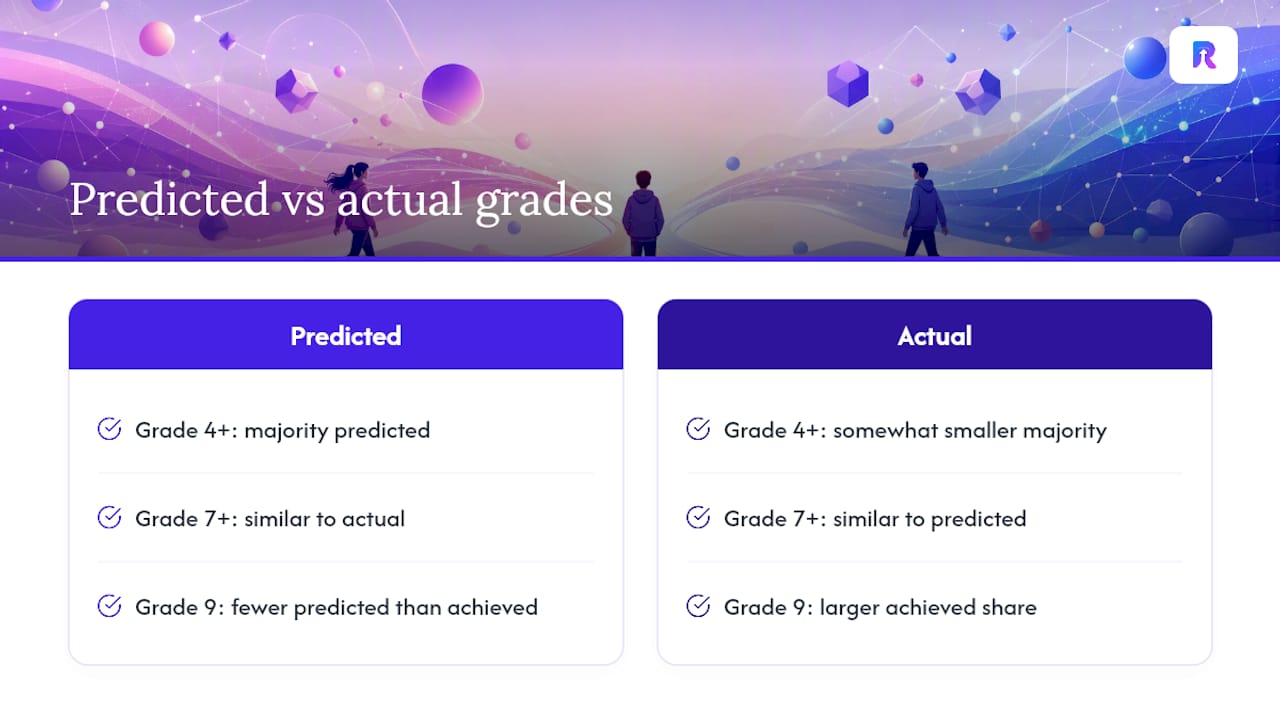
The headline finding is that predictions tend to slightly over-predict at the lower end and under-predict at the top. Cohort-level figures look tidy; individual-level accuracy is messier.
Subject-level variability adds another layer. Marking reliability differs across subjects, so predictions in some areas are naturally more stable than in others. Tiering in subjects like Foundation and Higher Maths also affects how predictions translate into final grades, since a student sitting the Foundation tier cannot achieve above a grade 5 regardless of their performance.
If your result comes back lower than expected, you have options. You can request a clerical check, a review of marking, or a formal appeal through your school. These are handled by the awarding organisation (AQA, Edexcel, OCR, WJEC) and your school must submit the request on your behalf.
When are predictions set and who gets to see them?
Predictions follow a rough annual rhythm in Year 11, though exact timing varies by school.
- Autumn term: Baseline data and early classwork inform initial working grades.
- December/January: The main mock series takes place. This is the most important checkpoint for most students.
- January/February: Teachers review mock results and form updated predictions. Many schools share these with students and parents at this stage.
- Spring term: Predictions may be revised again as coursework is completed and further assessments are marked.
- Late spring: Final predictions are confirmed internally before the exam season begins.
At the awarding-organisation level, the summer 2026 data-exchange procedures require awarding organisations to create specification-level predictions from aggregated 2024 centre outcomes. Centres submit interim updates on Monday, Wednesday and Friday by 12:00, using Templates G1 and G2, with final GCSE reporting due by 12:00 on 4 August 2026.
Students and parents can ask to see the evidence behind a prediction at any point. A polite email to the subject teacher or head of faculty is the right starting point. Sixth forms and colleges receive predicted grades as part of the admissions process and use them to make conditional offers. UCAS uses A-level predicted grades for university applications; GCSE predictions feed into post-16 choices rather than university entry directly.
Do predicted GCSE grades actually matter?
Yes, in specific situations. No, in others. Here is where they count.
Where predictions have a direct impact:
- Sixth-form and college admissions. Many oversubscribed sixth forms and FE colleges use predicted grades to shortlist applicants before results day. A predicted grade below the entry requirement can mean a conditional offer or no offer at all.
- Internal monitoring and support. Schools use predictions to identify students who need extra intervention, revision sessions or pastoral support before exams.
- Awarding-body statistical modelling. Awarding organisations use aggregated centre predictions to create specification-level benchmarks, as set out in the 2026 data-exchange procedures.
Where predictions matter less:
- University applications. Universities primarily use A-level predicted grades for UCAS applications. GCSE grades on a UCAS form are the actual results, not predictions.
- Employer applications. Most employers ask for actual GCSE results, not predictions.
As guidance for parents notes, predictions are working estimates used for monitoring and admissions, and they can be revised as pupils improve. A prediction is a snapshot, not a sentence.
How can you improve your predicted GCSE grade?
You have more influence over your prediction than you might think, especially if predictions have not yet been finalised.
Action checklist:
- Complete timed past-paper practice and keep your marked scripts as evidence.
- Collect marked classwork and any teacher-annotated work that shows improvement.
- Attend any intervention or booster sessions your school offers.
- Ask your teacher for a short review conversation and bring your evidence with you.
- Show consistent improvement across at least two or three assessments, not just one good day.
Pro Tip: Teachers treat consistent improvement as stronger evidence than a single high score. Three marked past papers showing a clear upward trend carry more weight in a review conversation than one excellent result.
A short, polite email works well when asking for a review. Here is a template you can adapt:
Examrevizo's practice-paper tools log your topic-level progress and past-paper performance over time, giving you a concrete record to bring to that conversation. The grade-boundaries estimator also helps you convert mock scores into provisional grade estimates before official boundaries are published.

Common myths about predicted GCSE grades
Myth 1: Predicted grades are fixed once they are set. Fact: They are not. Schools can and do revise predictions as new evidence comes in. If you improve significantly after your mocks, ask for a review.
Action: Keep a record of your marked work and request a review conversation with evidence in hand.
Myth 2: A predicted grade is the same as your final result. Fact: Predictions and results regularly differ. FFT Education Datalab's analysis of around one million grade pairs shows that individual-level mismatches are common, in both directions.
Action: Use the prediction as a planning tool, not a verdict. Focus on what you can control between now and exam day.
Myth 3: Predicted grades always favour students. Fact: The national data shows slight over-prediction at grade 4 and above, but under-prediction at grade 9. Some students are predicted lower than they eventually achieve.
Action: If you believe your prediction is too low, gather your evidence and have a calm, factual conversation with your teacher.
Use predictions as a planning tool. They tell you where you are, not where you will finish.
How do predicted grades differ from your actual GCSE results?
The core difference is timing and certainty. A predicted grade is formed months before the exam, based on available evidence. An actual result is produced after your scripts are marked by an external examiner against that year's grade boundaries.
Several things can shift the gap between prediction and result. Your performance on the day matters, as does the difficulty of the paper and where the grade boundaries land. A student predicted a 5 might sit a slightly easier paper than expected and achieve a 6, or face a harder one and come out with a 4. Neither outcome means the prediction was wrong at the time it was made; it means exams carry genuine uncertainty.
Predicted grades are also formed before final grade boundaries are set. Schools use previous years' boundaries as a rough guide, but the actual cut-off for each grade is only confirmed after national marking is complete. This is one reason predictions are described as estimates rather than forecasts.
What do Ofqual and awarding organisations say about predictions?
Ofqual regulates the qualifications system in England and sets the framework within which awarding organisations (AQA, Edexcel, OCR, WJEC) operate. Awarding organisations publish their own centre guidance on how predicted grades should be formed and submitted.
The summer 2026 data-exchange procedures published on GOV.UK set out the formal reporting requirements. Awarding organisations must create specification-level predictions from aggregated 2024 centre outcomes for 16-year-olds, submit interim updates three times a week by 12:00, and complete final GCSE reporting using Templates G1 and G2 by 12:00 on 4 August 2026. Template G3 covers additional reporting requirements.
These procedures exist to give the system transparency and consistency. They are primarily operational, governing how awarding organisations report data, rather than dictating exactly how individual teachers form their estimates. The professional judgement of teachers, moderated within the school, remains central to the process.
How to formally query or appeal a predicted grade
If you disagree with your predicted grade, the right approach is measured and evidence-based.
Step 1: Talk to your subject teacher first. Bring your marked work, mock scripts, and any other evidence of recent improvement. Ask specifically what evidence was used and whether there is scope for a review.
Step 2: If the conversation with your teacher does not resolve the issue, escalate to the head of faculty or head of year. Schools have internal review processes, and a head of centre can authorise a change.
Step 3: For formal complaints about how a school has handled a prediction, the school's complaints policy is the correct route. Ofqual does not adjudicate individual predicted-grade disputes; its role is regulatory rather than case-by-case.
One important distinction: a formal appeal against an actual exam result (after results day) is a separate process handled by the awarding organisation. Predicted grades are internal school documents, not official qualifications, so the appeals process that applies to marked scripts does not apply to predictions.
How predicted grades shape your post-16 options
For most Year 11 students in England, the most immediate consequence of a predicted grade is whether a sixth form or college will make you an offer.
Oversubscribed sixth forms often set entry requirements of grade 5 or above in specific subjects, and some require grade 6 or 7 for A-level courses in that subject. If your predicted grade falls below the threshold, you may receive a conditional offer (dependent on your actual results), be placed on a waiting list, or not receive an offer at all. This is why predictions produced in January and February of Year 11 carry real weight: they are what admissions teams see when they process your application.
FE colleges tend to be more flexible, but popular courses in areas like health and social care, engineering, or computing often have grade requirements too. Vocational routes such as BTECs may use predicted grades alongside other criteria.
The practical advice is straightforward: apply early, be honest on your application, and if your predicted grade is borderline, contact the institution directly to explain your trajectory. Many admissions teams respond well to a student who can show consistent improvement and a clear plan.
Predictions are a starting point, not a ceiling
There is a tendency to treat a predicted grade as a verdict, and that framing does more harm than good. A prediction is a teacher's best estimate based on the evidence available at a specific moment. It is not a measure of your potential.
What I find most useful about predictions is that they force a conversation. When a student asks their teacher "what evidence did you use, and what would change it?", they are doing something most students never do: treating their own education as something they can actively shape. That question, asked calmly and with evidence in hand, is often the most productive five minutes of a student's Year 11.
Examrevizo was built partly to make that conversation easier. When you can show a teacher a record of your past-paper scores improving over six weeks, you are not just asking for a higher prediction; you are giving them a reason to grant one.
Examrevizo helps you build the evidence that changes predictions
Predicted grades respond to evidence, and Examrevizo gives you the tools to generate it.

The platform tracks your topic-level mastery, logs your practice-paper performance over time, and uses that data to estimate your current grade trajectory. Atlas, the built-in AI study assistant, generates exam-style questions and gives structured feedback on your answers, so every session produces something concrete. The GCSE practice paper bundles mirror official exam formats and come with full mark schemes, making timed practice straightforward.
Examrevizo supports your practice and evidence-gathering. It does not replace your teacher's professional judgement, and it does not guarantee a higher prediction. What it does is give you something real to bring to the conversation. Try the free tools at Examrevizo and see where your gaps actually are.
Sources
The sources below are the most reliable places to follow up on specific points in this article.
- Prediction accuracy at Key Stage 4 - FFT Education Datalab
- Gov
- Guide to determining predicted grades and ranking candidates - Cambridge International